
Your Full Report Is On It's Way To Your Inbox!
The report is run and should be in your inbox within 30ish minutes or less. In the meantime, if you want more details about your AI SEO report, you’ve come to the right place!
Want to talk with an AI SEO expert about your report?
How to Read Your GEO Grader Results
Your GEO Grader report is designed to give you clarity – not judgment.
Here’s how to make sense of what you’re seeing and how to use it.
Start With the Big Picture (Not the Score)
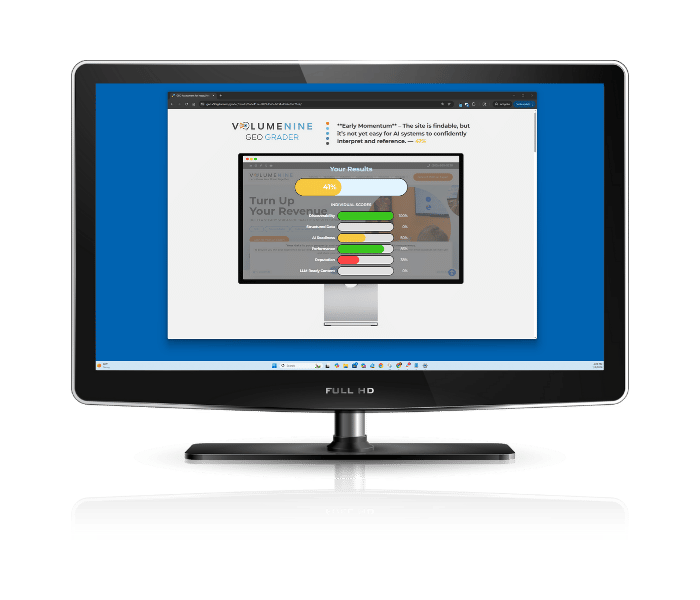
Your overall score is a snapshot, not a verdict.
It’s meant to help you understand how prepared your site is for AI-powered search today — not predict rankings, traffic, or outcomes. A lower score doesn’t mean your site is “bad,” and a higher score doesn’t mean you’re “done.”
Think of this as a baseline, not a finish line.
–> Want an AI SEO expert to look at your report and give you a quick assessment + plain English to-dos? Just send us an email at hello@v9digital.com along with a link to the report, and we’ll send that back your way!
What The GEO Grader Evaluates:
Discoverability
We evaluate whether search engines and AI crawlers can access, crawl, and index your content — because if AI can’t discover you, nothing else matters.
Structured Data
We check whether your site uses schema and authorship signals to define your brand, content, and people in a way AI systems can reliably interpret.
AI Readiness
We look for foundational credibility markers like awards, testimonials, clear company pages, and sitemap freshness that help AI systems contextualize and validate your business.
Performance
We assess mobile page speed and core performance metrics that affect how quickly AI systems can access and process your content.
Reputation & Trust
We analyze offsite signals and AI model perceptions to understand whether your brand appears consistent, credible, and trustworthy — or if red flags are holding you back.
LLM-Ready Content
We evaluate whether blog and resource pages are written, organized, and sourced to support AI summarization, citation, and recommendation.
What the Sections Mean
Your results are broken into six sections. Each one answers a different question AI systems implicitly ask about your site.
| Section | What it means | Why it matters |
|---|---|---|
| Discoverability | Can AI systems and search engines find and access your site? | If crawlers can’t reliably reach your pages, your content is much less likely to be surfaced as a source in AI-driven search experiences. |
| Structured Data | Do machines clearly understand who you are and what your content represents? | Structured signals like schema and authorship reduce guesswork, helping AI systems classify your site correctly and connect your brand and content to the right concepts. |
| AI Readiness | Does your site show basic credibility and clarity signals? | Trust markers like clear company information, testimonials, and awards help AI systems answer the implicit question: “Is this a real, credible brand?” |
| Performance | Is your site fast and usable on mobile? | Faster, more stable pages are easier for users to navigate and easier for machines to process, which supports overall visibility and source competitiveness. |
| Reputation & Trust | What does the rest of the web say about your brand? | AI systems rely on corroboration from reviews, mentions, press, and consistent brand signals across the web, not just what you say about yourself. |
| LLM-Ready Content | Is your content easy for AI systems to read, extract, and reuse? | Well-structured, clearly sourced content is more likely to be summarized accurately, referenced, and reused in AI answers. |
Want to talk with an AI SEO expert about your report?
How to Interpret Passes and Fails
Each check is binary: pass or fail.
That’s intentional.
A fail doesn’t mean something is broken — it means a clear signal wasn’t detected.
A pass doesn’t mean perfection — it means the baseline is there.
This keeps the grader consistent and removes subjective opinions.
How We Recommend Using Your Results
1. Look for patterns, not one-offs
If multiple issues point to the same theme (like trust, structure, or speed), that’s a priority.
2. Fix fundamentals before tactics
If AI can’t find or understand your site, advanced tactics won’t stick.
3. Use this as a baseline
Run the grader again after major changes to see how your readiness evolves.
What This Report Is — and Isn’t
This report is:
A diagnostic snapshot of AI search readiness
A way to learn what matters for AI SEO
A tool to guide prioritization and conversations
This report is not:
A full GEO Audit
A traffic guarantee
A replacement for strategy or execution
A few of the things our tool is looking at:
Can AI & Search Crawlers Access Your Site?
If AI systems can’t crawl your site, they can’t understand or recommend it. We check whether bots are allowed in and critical pages are indexable.
Authorship & Content Ownership
AI systems care who wrote something, not just what was written. We verify that content is clearly attributed to real, non-generic authors.
Identity Consistency Across the Web
Inconsistent names or addresses create confusion for AI systems. We flag discrepancies that make it harder for machines to confidently identify your brand.
Homepage Signals That Define Your Brand
Your homepage sets the context for everything else. We evaluate whether titles, metadata, and structure clearly communicate who you are and what you do.
Mobile Performance & Load Speed
Slow sites are harder for both users and AI to process. We measure real mobile performance to ensure pages load quickly and reliably.
Social & Press Signals
Established brands leave a trail. We look for social profiles and press coverage that signal real-world presence and authority.
Sitemaps That Help AI Stay Current
Sitemaps help AI systems discover and prioritize your content. We check for proper sitemap setup and freshness signals that indicate what’s new or updated.
Foundational Brand Credibility Signals
Trust starts on your own site. We check for awards, testimonials, and company pages that help AI validate your legitimacy.
Content Structure for AI Extraction
AI prefers content that’s easy to scan and summarize. We evaluate headings, section size, early answers, and formatting that support AI comprehension.
Structured Data & Entity Clarity
Schema helps machines understand your organization, content, and authors. We look for clean, consistent structured data that removes ambiguity.
Offsite Brand Reputation
AI doesn’t rely on your website alone. We analyze whether reviews, mentions, and third-party signals reinforce — or undermine — trust in your brand.
Sourcing, Freshness & Credibility
AI systems favor content that’s current and supported. We check for outbound sources, visible dates, and updates that reinforce reliability.